
- info@greathimalayastrek.com
- Kailash Manasarovar Departure Date 2025
 Quick Information
Overviews
The Upper Dolpo Circuit Trek takes
you into the heart of the fabled “Hidden Land” or Beyul, a remote and mystical
region located in the rain shadow of the Himalayas along the Tibetan Plateau.
Isolated from the rest of the world by deep valleys, vast forests, and towering
mountains, Upper Dolpo was once off-limits to outsiders. This rugged and
pristine region now offers a rare opportunity to experience one of the most
untouched and culturally rich parts of Nepal.
Beginning in Juphal, the trek winds
through lush forests, steep mountain passes, and hidden valleys, leading you to
the stunning Phoksundo Lake and the sacred Shey Gompa monastery. Along the way,
you'll pass through traditional Dolpo villages where Tibetan culture thrives,
and you'll have the chance to engage with the locals, who have preserved their
way of life for centuries. The trek also includes encounters with unique flora
and fauna, as Dolpo is home to diverse species, making it a paradise for nature
enthusiasts.
Though demanding, with
high-altitude passes exceeding 5,000 meters, the rewards are immense. From the
serene Phoksundo Lake to the ancient Bon monasteries of Ringmo and Shey, the
trek is a journey through both natural beauty and spiritual heritage. You’ll
cross passes like Kang La (5,350 m/17,552 ft), Shey La (5,100 m/16,732) and
Jeng La (5,110 m/16,765 ft), offering breathtaking views of the surrounding
landscape. The experience also includes visits to major Dolpo settlements like
Saldang and Dho Tarap, where you’ll witness a way of life deeply intertwined
with Tibetan traditions.
The Upper Dolpo Circuit Trek is
perfect for those seeking an adventurous and culturally enriching experience in
one of Nepal’s most secluded regions. The journey provides ample opportunities
to explore ancient monasteries, marvel at high-altitude landscapes, and enjoy
peaceful, crowd-free trails through a land largely untouched by modernity.
Starting Your Adventure:
Your epic journey commences in Jomsom, where you can choose between a scenic flight or a picturesque drive to reach the trailhead. As you trace the enchanting course of the Kali Gandaki River, you'll be drawn deep into the heart of the mystical Upper Dolpo region. Along this path, you'll traverse verdant valleys, arid desert-like expanses, and bear witness to astonishing geological formations, including wind-sculpted cliffs and vibrant rock landscapes. The iconic red and ochre cliffs set against the backdrop of azure skies create a visual masterpiece.
Cultural Riches:
One of the most captivating facets of the Upper Dolpo Trek is its cultural wealth. This area once thrived as a vital trade route between Tibet and India, giving rise to a fusion of Tibetan Buddhism and indigenous traditions. Delve into the depths of ancient monasteries, explore fortified settlements, and immerse yourself in traditional villages that have remained unscathed by modernity for centuries. The walled city of Lo Manthang, adorned with intricately designed mud-brick structures and a regal palace, stands as a testament to the historical significance of the region.
Engaging with Locals:
The trek offers you the privilege of connecting with the warm and hospitable local communities. Villagers along the route maintain their timeless traditions, and observing their daily lives, from farming to yak herding, provides profound insights into the challenges and beauty of existence in this remote terrain.
Adventure and Natural Beauty:
The Upper Dolpo Trek seamlessly merges awe-inspiring natural beauty with profound cultural immersion. This odyssey through the "forbidden kingdom" promises trekkers a once-in-a-lifetime adventure, where ancient trails, hidden monastic treasures, and encounters with a way of life that has endured for generations await. It's the perfect fusion of adventure, culture, and breathtaking landscapes, making it an ideal choice for those seeking an off-the-beaten-path trekking experience in Nepal.
Additional Highlights
Explore the Fabled Hidden Land: Discover the remote and mystical
region of Upper Dolpo, a place rich in Tibetan culture and largely untouched by
the modern world.
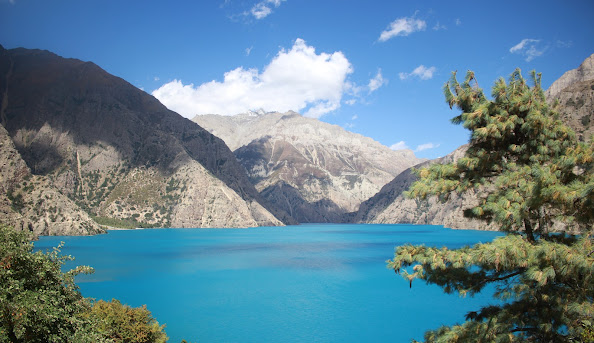
Stunning Phoksundo Lake: Marvel at the turquoise waters of
Phoksundo Lake, Nepal’s deepest lake, set against dramatic cliffs and
snow-capped peaks.
Shey Gumba and Crystal Mountain: Visit the sacred Shey Gumba
monastery, one of the most important religious sites in Dolpo, and witness the
spiritual heart of the region, Crystal Mountain.
High Mountain Passes: Challenge yourself by crossing several
high-altitude passes, including Kang La (5,350 m/17,552 ft), Shey La (5,100 m/16,732)
and Jeng La (5,110 m/16,765 ft), offering panoramic views of the Himalayas.
Traditional Villages and Tibetan Culture: Experience the unique
culture of Dolpo’s inhabitants, who live in harmony with the harsh environment,
preserving their Tibetan Buddhist traditions and ancient Bon religion.
Remote Wilderness: Trek through some of Nepal’s most remote and
least explored landscapes, from dense pine forests and deep valleys to barren,
wind-swept highlands.
Encounter Rare Flora and Fauna: Explore Dolpo’s pristine nature,
with opportunities to spot rare wildlife like the elusive snow leopard, blue
sheep, and a diverse range of plant species.
Trek Facts
Distance: Cover approximately 100 kilometers during the trek.
Altitude: Conquer the Chogo La Pass, the highest point on the trek, at 4,280 meters (14,041 feet).
Difficulty: Considered a moderate trek with some steep sections.
Best Time: Optimal trekking seasons are spring (March-May) and autumn (September-November).
Permits: Special permits are required for the Upper Dolpo region.
Accommodation: Enjoy the comforts of lodges and tea houses along the route, with advance booking recommended.
Cost: Trek costs can vary based on factors like trek duration, comfort level, and season, typically falling within the estimated range of $1,000-$2,000 for an 11-day trek.
In Conclusion
The Upper Dolpo Trek is an extraordinary adventure that beckons adventurers and cultural enthusiasts to explore the hidden treasures of Nepal's Himalayas. This expedition is more than a trek; it's a transformative journey that seamlessly weaves together breathtaking natural beauty, rich cultural heritage, and a profound sense of adventure.
The allure of the Upper Dolpo Trek lies not only in its scenic grandeur but also in its cultural depth. As you traverse arid terrains and follow age-old trails, you'll have the privilege of engaging with local communities whose traditions have remained unaltered for generations. The juxtaposition of their traditional way of life against the backdrop of ancient monasteries and mud-brick villages creates a tapestry of experiences that leaves an indelible mark on your soul.
Moreover, the Upper Dolpo Trek offers a sense of accomplishment that few adventures can rival. Conquering challenging passes and navigating remote and rugged terrain provides a profound sense of achievement. This trek isn't just about reaching the destination; it's about embracing the journey, relishing moments of cultural immersion, and cherishing memories that will endure for a lifetime.
In essence, the Upper Dolpo Trek is an odyssey through a hidden kingdom, a sanctuary where nature's beauty and human history converge. It's an expedition that transcends the ordinary, promising trekkers an unforgettable blend of adventure, culture, and exploration—a journey that will forever hold a special place in the hearts of those who undertake it. For those seeking an off-the-beaten-path adventure that leaves an indelible mark, the Upper Dolpo Trek beckons as an experience of a lifetime. Join us for this unparalleled adventure in the heart of the Himalayas.
Cost Include
Cost Exclude
Itenerary
Upon your arrival at Tribhuvan International Airport (1,340 m/4,396 ft) in Kathmandu, you will be warmly welcomed by our support team. They will assist you with your luggage and transfer you to your hotel in the heart of the city. Once you check in, take some time to rest and recover from your journey. At the hotel, you will be briefed about your trek and daily activities. If you’re up for it, you can start exploring the lively streets of Thamel, known for its bustling markets, shops, and restaurants. Enjoy a relaxing evening at your hotel, preparing for the exciting days ahead.
After breakfast at your hotel, set out on a guided sightseeing tour of Kathmandu. Your first stop is Swayambhunath Stupa (Monkey Temple), perched on a hilltop offering panoramic views of the city. Next, visit Pashupatinath Temple, a sacred Hindu site on the banks of the Bagmati River, where you might witness traditional cremation rituals. Afterward, head to Boudhanath Stupa, one of Nepal’s largest and most significant Buddhist stupas, surrounded by monasteries and vibrant Tibetan culture. After lunch at a local restaurant, continue to Patan Durbar Square, renowned for its exquisite Newari architecture and historic temples. Return to your hotel in the evening, where you can relax or explore Thamel further if you wish.
The morning offers a perfect opportunity to unwind, explore the city, or pick up any last-minute trekking gear. In the afternoon, you’ll board a short flight from Kathmandu, soaring towards Nepalgunj (158 m/518 ft), a bustling town on the Indian-Nepal border nestled in the Terai lowlands. The warm, sub-tropical climate of this region envelops you as you arrive, making the cool, comfortable atmosphere of your guesthouse a welcome relief. Here, you’ll settle in for an overnight stay, resting up for the journey ahead.
Flights to Dolpo are scheduled early in the morning, typically before 10 a.m. After a scenic 35-minute flight, you’ll descend into Juphal airstrip (2,500 m/8,202 ft), where your trek adventure begins. At Juphal, you’ll be greeted by your trekking. Your trek starts with a downhill walk to Kalagauda, following the peaceful Thuli Bheri riverbank until you reach Dunai (2,091 m/6,860 ft). Here, you’ll take some time to rest. In the evening, you’ll explore the nearby Bon and Buddhist monasteries, adding a cultural touch to the day.
From Dunai, you’ll continue along the Thuli Bheri River, descending until you reach Suligad. Here, the path shifts as you follow the Suligad/Phoksundo Khola (River), which flows from the stunning Phoksundo Lake, winding through a steep, densely vegetated valley. The trail varies, sometimes running close to the river and at other times high above the roaring white-water rapids. Along the way, you’ll pass through scattered villages, some of which feature deserted stone houses. At Kageni (2,267 m/7,437 ft), you’ll pause for lunch. These villages are often occupied only in winter when the Upper Dolpo communities bring their livestock down from the higher pastures. During your trek, they may be nearly hidden by overgrown tall grasses. After your meal, you’ll cross the Anke Khola (2,484 m/8,150 ft), and as the afternoon heat rises, we follow the river upstream to our campsite at Chhepka (2,660 m/8,727 ft).
Today you’ll traverse and re-traverse the river numerous times as you ascend through the narrow gorge, following a winding trail that meanders through bamboo forests, coniferous woods, and the verdant vegetation of Shey Phoksundo National Park. At one point, the trail steeply ascends for over an hour, leading you from the dense forest into open meadows adorned with vibrant wildflowers. As the valley gradually widens, the trekking becomes more manageable until you arrive at a bridge leading to the small village of Rechi (3,033 m/9,951 ft), where you’ll stop for a well-deserved lunch. Beyond Rechi, the valley constricts again, and the trail continues to undulate as you navigate the rugged spurs of the steep hillside. At the junction of the Suli Khola and Pungmo Khola, lies Samduwa (3,087 m/10,128 ft). From there you’ll pass Tapriza School (3,125 m/10,252 ft) and cross to the west bank and reach Jharana Hotel (3,132 m/10,276 ft), where you’ll set up camp for the night.
From Jharana Hotel, you’ll ascend steadily, following the clear, sparkling waters of the Phoksundo Khola, which flows down from the serene Phoksundo Lake. Our route takes us past Polam (3,266 m/10,715 ft), a deserted winter village, and leads us up to a ridge that separates the expansive fields of Rigmo from the steep, narrow valley below. As you climb, you’ll be rewarded with the breathtaking sight of one of Nepal’s tallest waterfalls (167 m/548 ft) cascading far beneath you. Then you’ll pass through lush forests, then climb again to reach the picturesque Dolpo-pa village of Ringmo (3,634 m/11,923 ft), known for its flat-roofed stone houses, ornate chortens, and walls adorned with prayer-carved mani stones. Here, you’ll set up camp by the tranquil shores of Phoksundo Lake.
On our acclimatization day, you can fully immerse yourself in the stunning natural beauty and rich cultural heritage of the Phoksundo Lake region. This day is crucial for adjusting to the altitude and allows you to explore the picturesque surroundings at a relaxed pace. Rigmo Village is situated near the serene Phoksundo Lake. Rigmo is a Dolpo village known for its traditional charm and vibrant cultural heritage. The village is renowned for its flat-roofed stone houses and welcoming atmosphere. As you wander through Rigmo, you’ll notice the impressive chortens and mani walls that are intricately carved with prayers, reflecting the deep spiritual life of its inhabitants. The villagers are primarily Dolpo-pa people, who practice the Bon religion, and their customs and daily activities offer a fascinating insight into the region's traditional lifestyle. You can visit Bon Monastery on the other side of the lake which was built in the 15th Century. The Bon Gumba in Rigmo is a significant spiritual site, deeply rooted in the ancient Bon religion, which predates Tibetan Buddhism. The gumba serves as a center for spiritual practice and community gatherings, where locals and pilgrims come together to perform rituals, chant prayers, and celebrate festivals. Phoksundo Lake is one of Nepal’s most breathtaking natural wonders. It is the second deepest and second largest lake in the country. This deep blue lake, framed by cliffs and surrounded by lush forests and high mountain peaks, is renowned for its striking turquoise color, which contrasts beautifully with the surrounding landscape. The lake is a sacred site for the local communities, with its pristine waters reflecting the area’s spiritual significance. The trek around the lake provides stunning views of the surrounding mountains, including the towering peaks of the Kanjirewa Himal.
You’ll commence on your trek to Shey Gompa in Inner Dolpo, starting with a dramatic path that hugs the western edge of Phoksumdo Lake. This thrilling trail, carved into steep rock faces, is supported in places by wooden trestles woven with saplings and covered with stones, offering breathtaking views of the pristine turquoise lake below. With the precarious nature of the path, it is essential to tread carefully. The trail was famously showcased in Eric Valli’s acclaimed film Himalaya (Caravan), which depicts the challenging lives of Dolpo’s people as they transport salt from Tibet over rugged passes to trade for essential grain. After navigating this high traverse, you’ll climb to a ridge where the panorama unfolds: the shimmering lake, lush green forests, vibrant fields of Ringmo, and the snow-capped peak of Kang Norbu to the south. A cairn adorned with prayer flags marks our high point at just over 4,000 meters (13,123 feet), from where you’ll descend gradually to the lake’s northern shore to a camping spot (3,700 m/12,139 ft).
From the northern shore, you’ll follow the flat riverbank and traverse through pine forests at the base of Mt. Kanjirewa. As you advance, the Phoksundo Valley narrows dramatically, flanked by towering rock walls on either side. You’ll encounter several tributaries that may require wading. Then, you veer away from the main valley and head north into a constricted gorge. Here, the trail becomes less defined, and you’ll undertake a strenuous climb up the steep valley sides, passing through occasional grazing areas and crossing numerous side streams. This path leads you to a campsite Kang La Base Camp (4,600 m/15,092 ft), also called Pass Camp or Snowfields Camp.
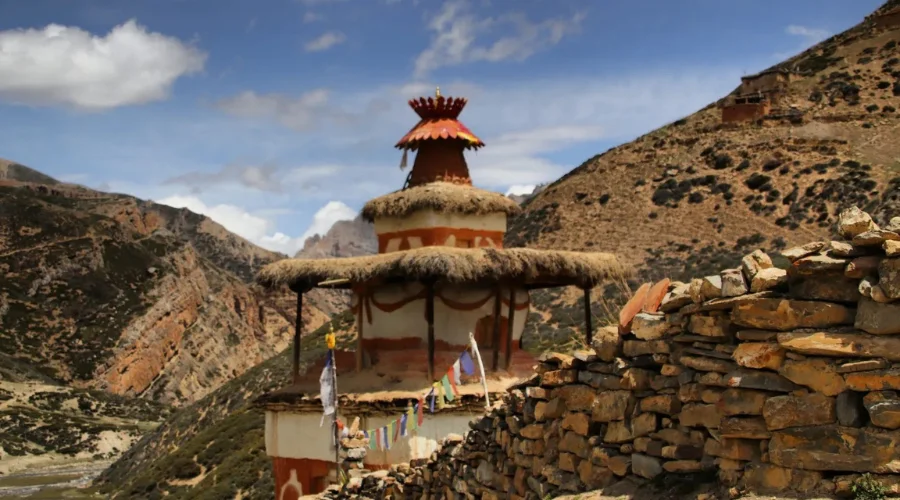
It will take you 2 to 3 hours to climb the loose slate scree slopes, which may be covered in snow, to reach the summit of Kang La (also known as Ngangda La, 5,350 m/17,552 ft). This high pass serves as a gateway to Upper Dolpo and is adorned with cairns and fluttering prayer flags. After your ascent, you’ll descend steeply for about 45 minutes to the valley floor and then follow the river’s course for an additional 3 hours to reach Shey Gumba (4,370 m/14,337 ft). The entrance to Shey Gumba is marked by red and white chortens and winding lines of mani stones. Located beneath the enigmatic Crystal Mountain, the monastery sits on a small grassy area at the confluence of two rivers. While the gumba itself, surrounded by a few red-painted buildings, might not be imposing, its dramatic setting makes it a revered site for both Buddhists and followers of the Bon religion. You’ll set up your camp just below the gumba, in a meadow dotted with a few herders’ huts.
Today you’ll have a day to relax, catch up on laundry, and handle other camp chores. In the afternoon, you’ll set out on a side trip to explore the remarkable Kagyupa monastery of Tsa Kang, which clings to a narrow ledge high on a cliff face. To reach this stunning site, you’ll follow part of the pilgrimage trail used by those making the ‘Kora’—a sacred circuit around Crystal Mountain. After visiting the monastery, you’ll return to Shey Gumba.
Continuing your exploration of Upper Dolpo, you’ll head east up a narrow valley and ascend to the summit of the Shey La (5,100 m/16,732 ft). From this high vantage point, the breathtaking views unfold, revealing the vast, arid expanses of the Tibetan Plateau to the north and the rugged terrain of Mustang to the east. After soaking in the panoramic scenery, you’ll descend into the pastures of Namgung (4,414 m/14,482 ft), where a cluster of stone houses and a relatively new gumba await you.
Today features a shorter trek, starting with a stunning traverse high above the Namgung Khola before descending steeply into the sizable Dolpo-pa village of Saldang (4,070 m/13,353 ft). Situated near the Tibetan border, Saldang is a key point for yak caravans that transport Tibetan salt, an essential trade commodity exchanged for rice from the southern lowlands—a tradition that endures in Upper Dolpo. This collection of five separate villages is the largest settlement in the region. You’ll set up camp at Saldang (4,070 m/13,353 ft) and have the afternoon to explore and enjoy our surroundings.
Departing Saldang, you’ll head south along the Nagaon Khola, meandering through terraced barley fields—the staple crop of Dolpo’s farmers. As you pass the dispersed village of Namdo, you’ll encounter two monasteries: one nestled beside the river and the other perched high on a cliff. Your camp for the night is set near the smaller settlement of Sibu, situated at 4,150 meters (13,615 feet).
The day starts smoothly as you follow the river’s course. After about two hours of trekking, you’ll veer away from the main river and ascend sharply to a yak grazing area at 4,850 meters (15,912 feet), located below the Jeng La. This will be your campsite for the night.
The climb to the summit of the pass, Jeng La at 5,110 meters (16,765 feet), is steep and takes about two hours. Once you reach the top, you’ll be rewarded with breathtaking views southward towards Dhaulagiri. Descending from the pass, you’ll enter the vast Tarap Valley and follow a stream to Tokyu Village, where you’ll set up camp at an altitude of 4,160 meters (13,648 feet).
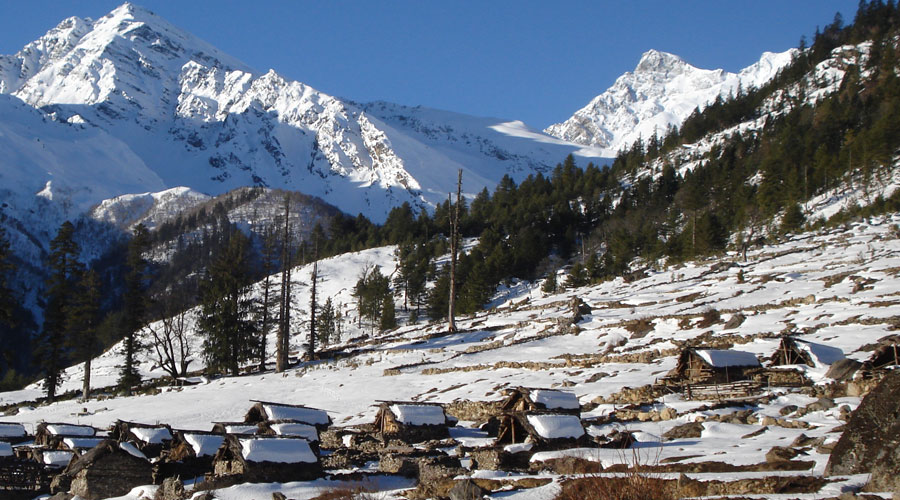
Unlike the rugged trails you’ve traversed so far, the path down the Tarap Valley is well-trodden and well-maintained, offering a relatively easy descent through a broad, fertile landscape. Alongside the Tarap Chu, you’ll encounter several gumbas and have the chance to explore Dho Tarap, a charming cluster of stone houses nestled below the Ribo Bhumpa Gumba. This gumba is distinguished by its unusual chorten, which is set within the arch of a larger chorten. The local women wear striking headpieces of beaten silver, known as ‘tikpu,’ and adorn themselves with turquoise, amber, and zee stones. Men in Dolpo often sport red woolen braids, reminiscent of the Khampas of Eastern Tibet. The region is prone to fierce anabatic winds from late morning to sunset, similar to those in the Kali Gandaki Valley. The architecture and layout of the houses reflect this challenge. You’ll continue to Yak Kharka, a less windy area beyond the village, where you’ll set up camp at 4,020 meters (13,189 feet).
Today you’ll descend gradually along the river, crossing to the west bank and continuing beneath towering cliffs. The trail leads you over a ridge adorned with two ancient chortens. As you drop down to the pastures of Shishul Khola, you’ll enter a realm frequented by large herds of blue sheep, or bharal. Beyond, you’ll navigate a series of bridges, both old and new, as you cross and re-cross the Tarap Chu. Finally, you’ll reach the grazing area of Shim Ora at 3,647 meters (11,965 feet), where you’ll set up camp for the night.
Today’s trek takes you through the captivating gorges of the Tarap Chu on a meticulously engineered trail, featuring flights of stone steps predominantly on the west bank of the river. After about four hours of descent, you’ll pause for a well-deserved lunch break. The journey continues for another 2 to 3 hours, leading us to Kanigaon, where a police check postmarks your arrival. You’ll set up camp just outside the village, situated beneath a stand of juniper trees beside the river. At an elevation of 2,620 meters (8,596 feet), the temperature is noticeably warmer, offering a pleasant change from the cooler high-altitude air.
Departing from Kanigaon, you’ll approach the confluence of the Tarap Chu and Bharbung Khola, crossing the latter via a high-suspension bridge. The trail continues, often perched high above the river, with a series of undulating sections leading to a final descent into Tarakot (2,281 m/7,484 ft), where you’ll set up camp just below the village. Today’s trek is relatively short, taking approximately 2 to 3 hours. After lunch, you have the option to undertake a 1-hour, 400-meter ascent to the impressive, fortified settlement of Gumba Tara, home to a historic monastery. In this lower valley, you’ll find 13 settlements collectively known as Tichurong.
Today, you complete our trekking circuit as you follow the Bharbung Khola, which eventually merges into the Bheri River, reaching Dunai (2,091 m/6,068 ft). The trek leaves you with a free afternoon to relax and explore. Dunai offers a few small lodges, and for those in the mood, a local beer might be found.
As you continue alongside the Bheri River, the trail presents us with beautiful stretches of large conifers. However, there’s a final challenge as you climb through terraced farmland to reach the Jhupal airstrip (2,500 m/8,202 ft). You’ll set up camp beside the airstrip for our final night, ready to celebrate with our crew. This marks the end of our trek through one of Nepal’s most spectacular regions, and it’s time to savor the accomplishment of completing this remarkable journey.
The early morning flight swiftly transports you from the crisp, cool heights of Dolpo to the warm and humid Terai region at Nepalgunj (158 /518 ft). After a brief stop, you’ll catch our connecting flight to Kathmandu (1,340 m/4,396 ft). Arriving in the city, you’ll check into your hotel, eager for a refreshing clean-up and perhaps a glance in the mirror. Tonight, you’ll embrace the vibrant energy of Kathmandu, indulging in fine dining and immersing yourself in the lively pulse of the city’s bustling streets.
This day serves as a contingency in case your weather-dependent flight from Jhupal encounters any delays. If everything proceeds as planned, it’s a chance to unwind and savor Kathmandu’s many delights.
Our team will accompany you to the airport for your journey back home. If you wish to extend your stay, there are plenty of exciting options like jungle safaris, white-water rafting, a tour of Tibet (Mount Kailash), or even mountain biking adventures. Feel free to ask us for details!
Route Map
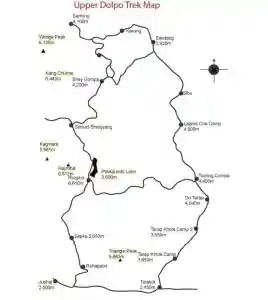 Gallery And Videos
Frequently Asked Question
Group Join Discount
| Nos Of Persons | price per person |
|---|
Upcoming Fixed Departure
| Trip Name | Departure Date | Price | Trip Status | Action |
|---|
UpComming Fixed Departure
Package Reviews And Rating
Write Reviews
Enquiry For Further Information

showing varified reviews